

Medically reviewed by Milan Patel, M.D.
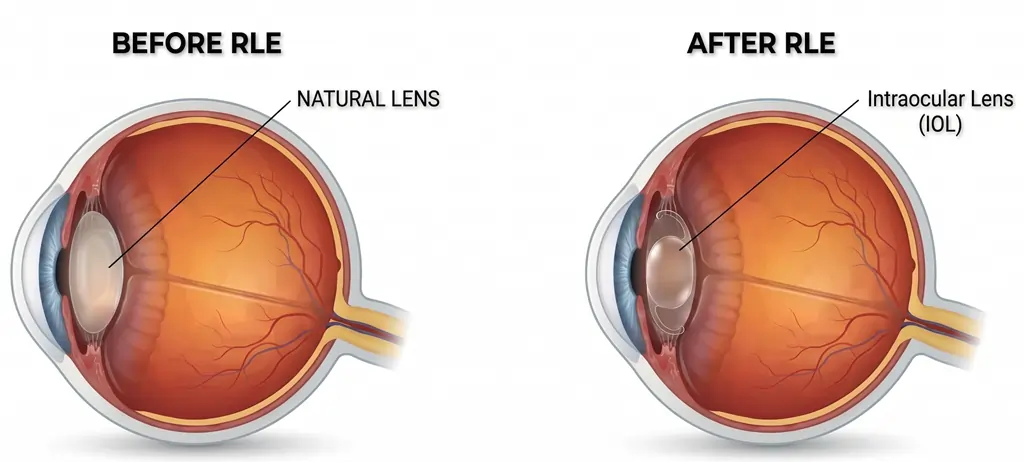
If you’re seeking long-term vision correction treatment and a potential alternative to Laser Vision Correction like LASIK, Refractive Lens Exchange (RLE) surgery in Atlanta may be the right solution for you. RLE replaces the eye’s natural lens with an artificial Intraocular Lens (IOL) to correct vision problems such as nearsightedness, farsightedness, astigmatism and presbyopia.
At Milan Eye Center, we offer individualized care and guidance to achieve exceptional visual outcomes with RLE (Refractive Lens Exchange). You can schedule a comprehensive eye examination today and explore the lasting benefits of RLE.
Patients in Atlanta choose Milan Eye Center for our high-quality services, positive recommendations, patient-centered care, and advanced tools and techniques. Our experienced surgeons are renowned for their expertise in RLE surgery, as well as LASIK, PRK, and ICL.
We’ve consistently delivered excellent visual outcomes across our multiple clinics in Atlanta and six state-of-the-art surgery centers. From comprehensive evaluations to accurate treatments and personalized postoperative support, we can provide a comfortable, safe, and trusted experience for those seeking lasting vision correction.
Refractive Lens Exchange (RLE) is a vision correction procedure typically recommended for individuals over 40 with age-related changes in their vision, but not cataracts. RLE can correct nearsightedness, farsightedness, astigmatism and presbyopia and is a strong alternative to LASIK (Laser-Assisted in Situ Keratomileusis) or PRK (Photorefractive Keratectomy). While LASIK or PRK is an optimal choice for people in their 20s to early 40s, its long-term benefits can be limited as the eye’s natural lens becomes less flexible with time. The natural lens eventually ages to become a cataract in a patient’s mid to late 60s.
In the mid-40s and beyond, RLE can be a more sensible choice. The procedure removes the natural lens in the eye and replaces it with a customized IOL that matches your visual needs. Unlike LASIK or PRK, where only distance vision can be typically corrected, RLE can help patients see far and close. Because the natural lens is removed at the time of this procedure, cataract surgery is never needed in the future. The procedure also enjoys the high degree of success and safety of traditional cataract surgery.
With LASIK and Refractive Lens Exchange, depending on your age, the results are quite similar but the procedures can vary significantly.
During a LASIK procedure, an incision is made in the cornea to create a flap of tissue. This flap is then lifted, and a laser is applied to the underlying corneal bed to reshape the cornea. The flap is then put back into its original position and allowed to heal naturally over the next several days. Antibiotic and steroid drops are used post-operative for a short period of time to aid in healing.
A significant advantage of Refractive Lens Exchange surgery for patients is that they will no longer need cataract surgery in the future. Barring development of other eye diseases, there is the potential of lifelong good vision without glasses. This has significant appeal for patients who do not want to have LASIK, only to need another procedure 10 or 15 years later. Additionally, for patients with glaucoma or elevated intraocular pressure, Refractive Lens Exchange surgery has the added effect of lowering intraocular pressure and it is bundled with the ability to place different lens options to ensure you are getting the vision results you want after surgery!
The RLE procedure has the same steps as cataract surgery, including removal of the natural lens and replacement with an artificial lens. The power of the artificial lens is selected to minimize the patient’s dependence on glasses. With a monofocal lens, patients can choose either near or distance vision, but with a multifocal lens, patients can achieve both near and distance vision thus lowering dependence on glasses.
The RLE procedure takes about 10-15 minutes per eye. It has little downtime with quick recovery, a predictable outcome, and results in an excellent quality of vision freeing you from using glasses or contacts. Desired outcomes are achieved within 1-2 days and you have the ability to resume normal activities in the same amount of time.
Long before the natural lens becomes a cloudy “cataract,” it is slowly becoming thicker, less flexible, and less clear. These changes, known as dysfunctional lens syndrome, can cause trouble with focusing for near vision, and create imperfections in the visual system called aberrations, that lead to increased glare and decreased the quality of vision.
If a patient in the age range of 40 to 50 years old has their vision corrected to see clearly in the distance with LASIK, they will still need glasses for reading. Also, since these patients are getting closer to the age where they will require cataract surgery, previous LASIK cause the calculations for the cataract surgery to become less accurate. For these reasons, it may be in these patients’ best interest to consider Refractive Lens Exchange surgery.
There are some risks with RLE eye surgery that are greater than the risks associated with LASIK. This is because LASIK is performed on the surface of the eye and RLE is a procedure that is performed inside the eye. Risks include intraocular infection, retinal tear or detachment, and swelling of the retina.
While cataracts are considered medically necessary to remove in a procedure that is covered by insurance companies, Refractive Lens Exchange surgery may not be covered if insurance companies do not consider the situation severe enough to warrant paying for surgery to correct it. Additionally, the cost of RLE with a multifocal lens is generally higher than the cost for LASIK.
In the RLE vs. LASIK debate, both procedures can deliver similar results, but they can differ in their eligibility, processes, and long-term benefits.
LASIK surgeons may recommend using antibiotic or steroid drops for a brief period after the surgery to accelerate healing.
Where LASIK is ideal for younger patients seeking quick visual improvements and have healthy corneas, RLE is recommended for patients in their 40s to 60s experiencing presbyopia and seeking a more permanent solution.
Additional RLE Eye Surgery Resources:

If you’re looking for a vision correction procedure that is more permanent or cannot be achieved with LASIK, you may be a good candidate for RLE.
RLE may be recommended when LASIK or PRK are not suitable due to thin corneas or higher refractive error. It is also ideal for people seeking clear, immediate, distant, or near vision with advanced lens technology that can also help prevent the formation of cataracts, and vision that is more permanent.
RLE isn’t recommended for people with moderate to severe glaucoma, severe dry eye, macular degeneration, or an unstable prescription. It is also not for pregnant women and those expecting outcomes that aren’t achievable with other lens implants.
At Milan Eye Center, we can schedule a comprehensive evaluation to determine whether RLE surgery is effective for your visual needs. Book your consultation today to see if you are a good candidate for RLE.
 Customized vision with Advanced IOL options
At Milan Eye Center, Refractive Lens Exchange (RLE) is never a one-size-fits-all procedure because your eyes, lifestyle, and vision goals are uniquely your own. That’s why one of the most important steps in your RLE evaluation is selecting the right Intraocular Lens (IOL).
Today’s IOL technology goes far beyond the standard monofocal and bifocal options. We offer a full range of advanced IOLs designed to maximize visual clarity, minimize dependence on glasses, and address specific refractive needs. These include:
Multifocal, Extended Depth of Focus and Full Visual Range IOLs – Provide clear vision at multiple distances, reducing or eliminating the need for reading glasses or bifocals.
Toric IOLs – Correct astigmatism at the time of surgery for sharper, more consistent focus.
By introducing these advanced technologies early in the planning process, your surgeon can tailor an RLE procedure that is truly personalized.
RLE is a customized vision-correcting procedure, so understanding all its specifics can help you make informed decisions. Here is a clear breakdown of what you can expect from your RLE surgery in Atlanta at the Milan Eye Center:
After you’ve watched a curated set of surgical animation videos, our highly experienced surgeon meets with you to understand your goals, review findings of the in-depth diagnostic testing and decide whether you are a candidate. Should you be, the appropriate IOLs are discussed along with their unique attributes to ensure they can deliver on your goals.
Before the procedure begins, our Nurse Anesthetist will give you a sedative through your IV. The goal is for you to be ‘in la-la land’ for the procedure, blissfully asleep, but arousable on command. Once topical anesthetic drops are administered, our surgeon will create a small incision at the edge of the cornea and gently remove the natural lens using advanced ultrasound technology. Then, your chosen IOL is inserted and correctly positioned to restore stable vision. It takes around 10 minutes per eye to perform the procedure under local anesthesia for accuracy and comfort.
You might experience slight blurriness or irritation during the first 12-24 hours, but as the eye adjusts, you will notice sharper vision within hours to a day. There will be continuous refinement over the next few weeks. To ensure proper healing and IOL positioning, routine follow-up care will also be essential and scheduled for you at a convenient office.
RLE, or refractive lens exchange, is a procedure more suitable for people who aren’t candidates for laser vision correction surgeries. If you’re curious to know more about this long-term solution to correcting your refractive errors, here are the answers to some frequently asked questions:
One of our ophthalmology experts can explain which implant would be the correct choice for your particular situation and unique vision. Make an appointment today at one of our eight convenient Atlanta-area locations.
Schedule an Appointment Online
Or call 678-381-2020